

The world doesn’t operate in silos, and neither do we. Our work thrives at the intersections—the spaces where health, education, and community overlap, where people live their lives and navigate their challenges every day. It’s also where the most complex problems emerge. These intersections demand innovative solutions, and that’s where Empact Global comes in.
The Intersections of Health, Education, and Community

Think about the connections between where people live, work, and learn. These intersections shape their experiences and opportunities, but they’re also where challenges cluster. For example:
-
- Environmental Justice and Housing: Poor housing quality in underserved neighborhoods often means exposure to mold, lead, and other environmental hazards, which directly impact health.
-
- Clean Air and Asthma: Communities located near highways or industrial areas face higher rates of asthma, which leads to increased school absenteeism and missed workdays.
-
- School Absenteeism and Health: Children with chronic illnesses like asthma miss school more often, affecting their academic performance and long-term success.
- Community Resources and Health Outcomes: Limited access to affordable healthcare, nutritious food, and safe recreational spaces disproportionately affects low-income communities, compounding health and education disparities.
When we design solutions at these intersections, we address root causes instead of symptoms. For example, improving housing quality in low-income areas can reduce asthma rates, which in turn keeps children in school and parents at work. The ripple effects are transformative.
The Intersections of Design, Strategic Foresight, Continuous Improvement, and Systems Thinking
Complex problems don’t have one-size-fits-all solutions. That’s why we combine methodologies like design, strategic foresight, continuous improvement, and systems thinking. These approaches are powerful on their own, but their true strength emerges at the intersections.
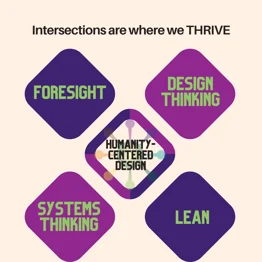 Organizations often face challenges that span people, processes, operations, strategy, and culture.
For instance:
-
- A school district may need to redesign its curriculum while addressing systemic inequities in teacher recruitment and retention.
-
- A health system may struggle to integrate new technology while maintaining patient-centered care.
-
- A nonprofit may aim to scale its impact while navigating funding constraints and shifting stakeholder expectations.
- By working at the intersections of these methodologies, I can:
-
- Design human-centered solutions that are actionable and inclusive.
-
- Use foresight to anticipate future challenges and opportunities.
-
- Apply continuous improvement to ensure solutions evolve and remain effective.
- Map systems to identify leverage points and interdependencies.
-
This integrated approach ensures we’re solving the right problems and building solutions that last.
The Intersections of Public, Private, Non-Profit, and Academia
We also work at the intersection of sectors—public, private, non-profit, and academia. Each sector brings unique strengths and perspectives, and when they collaborate, the possibilities are limitless.
-
- Public Sector: Governments bring scale and regulatory power, ensuring solutions reach the widest audience.
-
- Private Sector: Businesses drive innovation, efficiency, and funding opportunities.
-
- Non-Profit Sector: Nonprofits focus on community needs and equity, often acting as the voice for marginalized populations.
-
-
- Academia: Researchers and institutions provide data, analysis, and thought leadership to inform evidence-based decisions. Working at this intersection allows me to:
-
-
- Bridge gaps between sectors and foster collaboration.
-
- Combine resources and expertise to tackle systemic challenges.
- Ensure that solutions are not only innovative but also equitable and sustainable.
For example, addressing environmental justice requires policy changes (public sector), funding for clean energy initiatives (private sector), advocacy for impacted communities (non-profits), and data on health impacts (academia). Only by integrating these perspectives can we create lasting change.
Why It Matters
Intersections are where life happens. They’re where people and communities fall through the cracks. They’re where problems are most complex but also where solutions can have the greatest impact. By working at these intersections, we can:
-
- Address systemic challenges holistically.
-
- Create solutions that are equitable, sustainable, and future-ready.
- Bring together diverse perspectives to spark innovation.
We don’t live in a world divided into neat categories. The challenges we face—and the opportunities to solve them—exist at the intersections. That’s where we do our best work, and it’s where real transformation begins.