
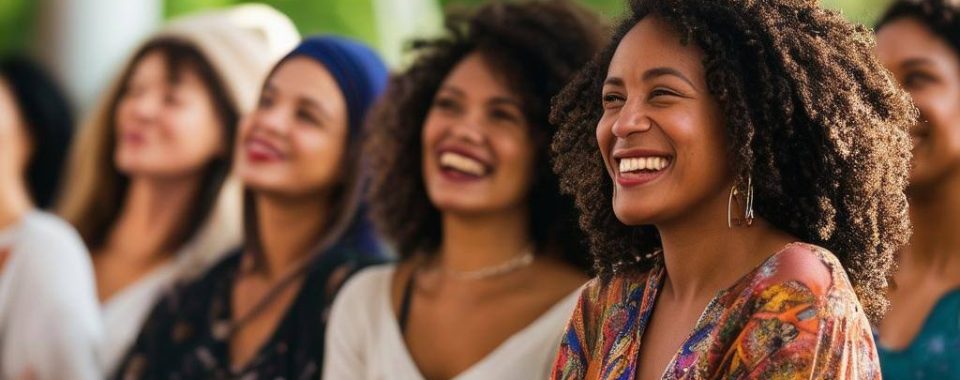
A few weeks ago, I attended the Women Leaders for the World fellowship retreat hosted by How Women Lead. It was an experience unlike anything I’ve ever had in my professional life, and it changed the way I think about diversity, equity, and inclusion (DEI). For the first time, I felt what it meant to belong—truly belong—and that realization was both freeing and heartbreaking.
The Weight of Belonging
I spent the first three days of the retreat crying. Not because I was sad, but because something inside me shifted. For the first time in my career, I experienced belonging. Real, unfiltered belonging where I could just be me. No mask, no code-switching, no adapting to fit in. And while that was a beautiful thing, it also made me sad. Sad because I realized how much of my career had been spent conforming, adapting, and fitting into molds that were never designed for me.
Belonging, as I’ve learned, is a powerful but complicated thing. For much of my life, I’ve been “the one”: the one Black cheerleader, the one Black woman in my engineering classes, the one Black female in every job I’ve had. Being “the one” often meant adapting to environments that weren’t created with me in mind. It meant wearing chinos and polos to fit in with my male colleagues, even though that’s not my style. It meant hiding parts of myself to be seen as professional, capable, and, most importantly, a “fit.”
The Problem with “Fit”
Organizations love to talk about hiring for “fit.” But what does that really mean? Too often, fit means hiring someone who looks, acts, and thinks like the people already in the room. It’s about smoothness, ease, and avoiding the discomfort of difference. But here’s the thing: the world doesn’t progress when we all think the same. Hiring for fit stifles innovation excludes valuable perspectives, and reinforces existing power dynamics.
And then there’s “executive presence.” This term has often been used to encourage conformity—to say, “Put on your mask. Act like us. Talk like us. Make us comfortable.” But for many of us, that’s exhausting. It takes a toll, not just on individuals but on teams, organizations, and the very cultures we’re trying to build.
A Better Way Forward
Belonging shouldn’t be a box to check or a nebulous organizational goal. Maybe it’s not about belonging at all. Maybe what we’re striving for is something simpler but just as powerful: acceptance. Acceptance means creating environments where people can show up as their full selves, not just the parts that feel comfortable or familiar to others.
One way to get there is by empowering business resource groups (BRGs). Too often, BRGs are treated as performative spaces, given little power or resources to drive real change. But these groups have the potential to be transformative when they’re supported and aligned with organizational strategy.
They can:
- Identify blind spots and advocate for systemic changes.
- Provide spaces for underrepresented employees to feel seen, heard, and valued.
- Act as bridges between leadership and the communities they serve.
A Call to Action
So here’s my ask: The next time you’re hiring, building a team, or setting strategic priorities, reflect on your own blind spots. Are you hiring for fit, or are you hiring to be challenged? Are you creating spaces where people can show up as their full selves, or are you forcing them to conform to a narrow definition of professionalism?DEI work isn’t easy, but that’s no excuse to give up on it. If anything, it’s a reason to dig deeper, to do better, and to push past the surface-level metrics that have too often defined success. Organizations have the power to create cultures of acceptance, where diversity isn’t just about numbers but about genuine inclusion and empowerment.Let’s move beyond the idea of belonging as something people have to strive for. Let’s create workplaces where acceptance is the norm, not the exception. And let’s stop settling for fit when what we really need is bold, transformative change.